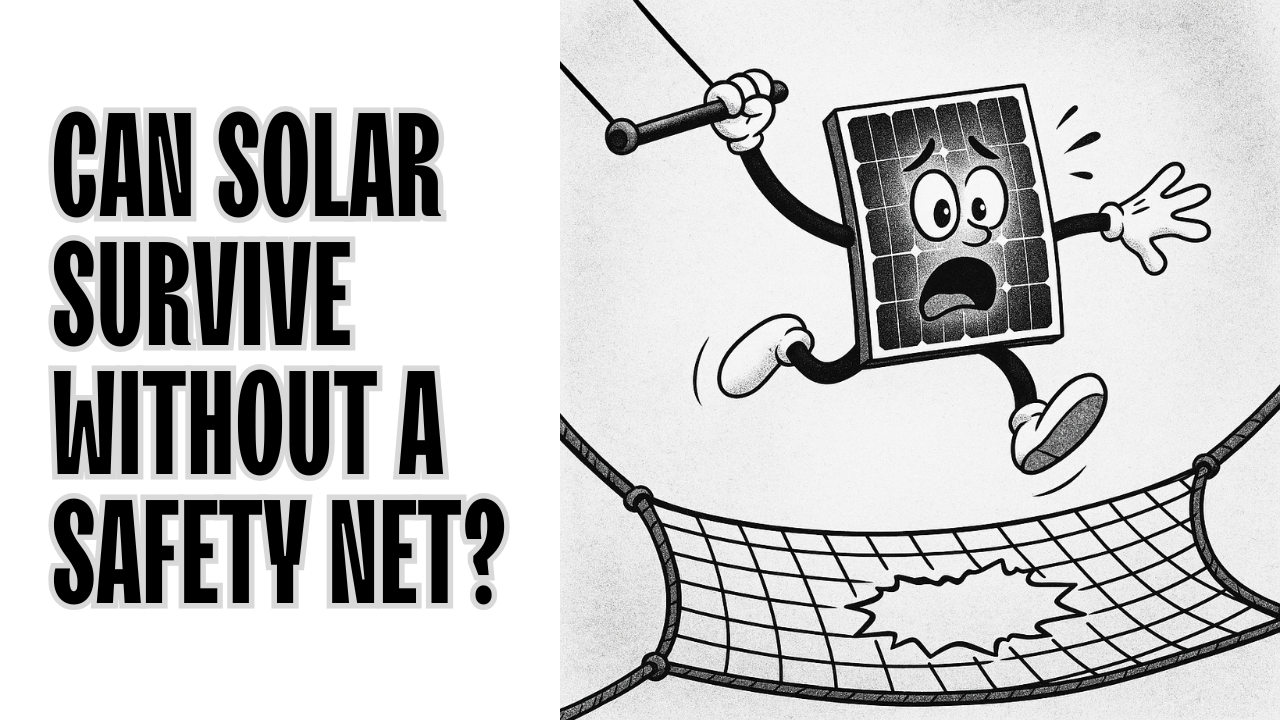
Solar Without a Safety Net: Are We Ready?
BY ERIN JOHNSTON
Once upon a time, America faced an oil crisis that sparked a movement toward alternative energy solutions.
In response, the federal government began investing in clean energy research and development. The Solar Energy Research Institute—now known as NREL (National Renewable Energy Laboratory)—was founded. Programs like the Federal Photovoltaic Utilization Program aimed to commercialize solar energy, and a new industry was born.
Over the following decades, solar began making its way into the residential market. Back then, American homeowners who chose solar weren’t chasing tax credits or financial gains. They were early adopters—driven by belief in renewable energy, not economic return.
They had no tax credits, no property value boost, no favorable lending options… and their systems didn’t always “pencil out.” Still, they bought in.
Fast-forward to 2025: solar is no longer niche—it’s mainstream. It’s affordable, accessible, and embraced across the country. Globally, the solar industry is valued at over $200 billion, with the U.S. accounting for more than 30% of that.
Solar has created jobs, stimulated economic growth, and made energy more affordable for millions of Americans.
Advertisement - continue reading below
“Removing the tax credit entirely would be like starving the baby. Hopefully, no one wants that.”
Distributed generation has strengthened grid capacity, reduced utility costs, and boosted resilience. It’s offset more CO₂ than any other renewable method and will continue to do so over its 30-year lifespan. Solar is now recognized as its own thriving economy. Publications like Forbes regularly spotlight young entrepreneurs building multi-million-dollar solar companies.
According to SEIA, the U.S. solar industry has now installed 235 gigawatts—enough to power more than 40 million homes, or nearly 30% of all households. The industry has grown 30% over the last decade, fueled by a combination of federal and state tax incentives, local rebates, Solar Renewable Energy Credits (SRECs), rapid technological improvements, and better financing options.
Believe it or not, some of us OGs remember when solar didn’t have tax credits or leases. There were no power purchase agreements, no net metering, no Zillow-approved home value increase. Cash was king, and installs ran over $8 per watt. Those were the industry’s early, scrappy days.
“Even without the federal credit, the solar industry is not helpless. In fact, it’s poised to adapt.”
Think of the solar industry as a baby—born into a world doing its best to raise it. We celebrated its birth, fed it with tax credits, and stayed up all night worrying when rates spiked or financing dried up. Some of us got tossed around. Some of us never got paid. But we kept going, nurturing this new thing, watching it grow from infancy into a strong, healthy toddler.
Now, with recent discussions about scaling back or eliminating the federal solar tax credit, it feels like the baby is crying. Do we console it… or let it cry it out?
It’s important to remember: while the industry was federally born, it takes a village to raise a child. Removing the tax credit entirely would be like starving the baby.
Hopefully, no one wants that.
If solar is in its toddler years, then sure—growth might slow a bit. But that doesn’t mean it’s failing. It means it’s maturing. Even without the federal credit, the solar industry is not helpless. In fact, it’s poised to adapt.
Over 40 states already offer property tax exemptions for renewables. More than 30 states have enshrined a Right to Solar. Over 20 offer sales tax exemptions. Ten offer SRECs. Five offer their own state-level tax credits. And beyond incentives, solar still has strong fundamentals: affordable financing, rising utility rates, increasing property values, and growing consumer demand.
The solar “baby” may not grow quite as fast—but it will still grow. With support from states, innovation from leaders, and continued momentum, the future is bright.
Just don’t throw the baby out with the bathwater.
Advertisement - continue reading below
About The Author

Erin Johnston
Erin Johnston is a Solar Business Consultant based in Northern California. With over a decade of experience in residential home improvement—including HVAC, plumbing, and solar—Erin specializes in home performance and energy efficiency. A UC Davis graduate, she is actively involved in her local Chamber of Commerce and also coaches high school softball.
💌 Did a friend share this with you?
That’s because they think you’ll love it. Get started with your own subscription for just $5 and never miss another issue!